
Complete Guide: How to Analyze a Soccer Match Step by Step (Professional Methodology)

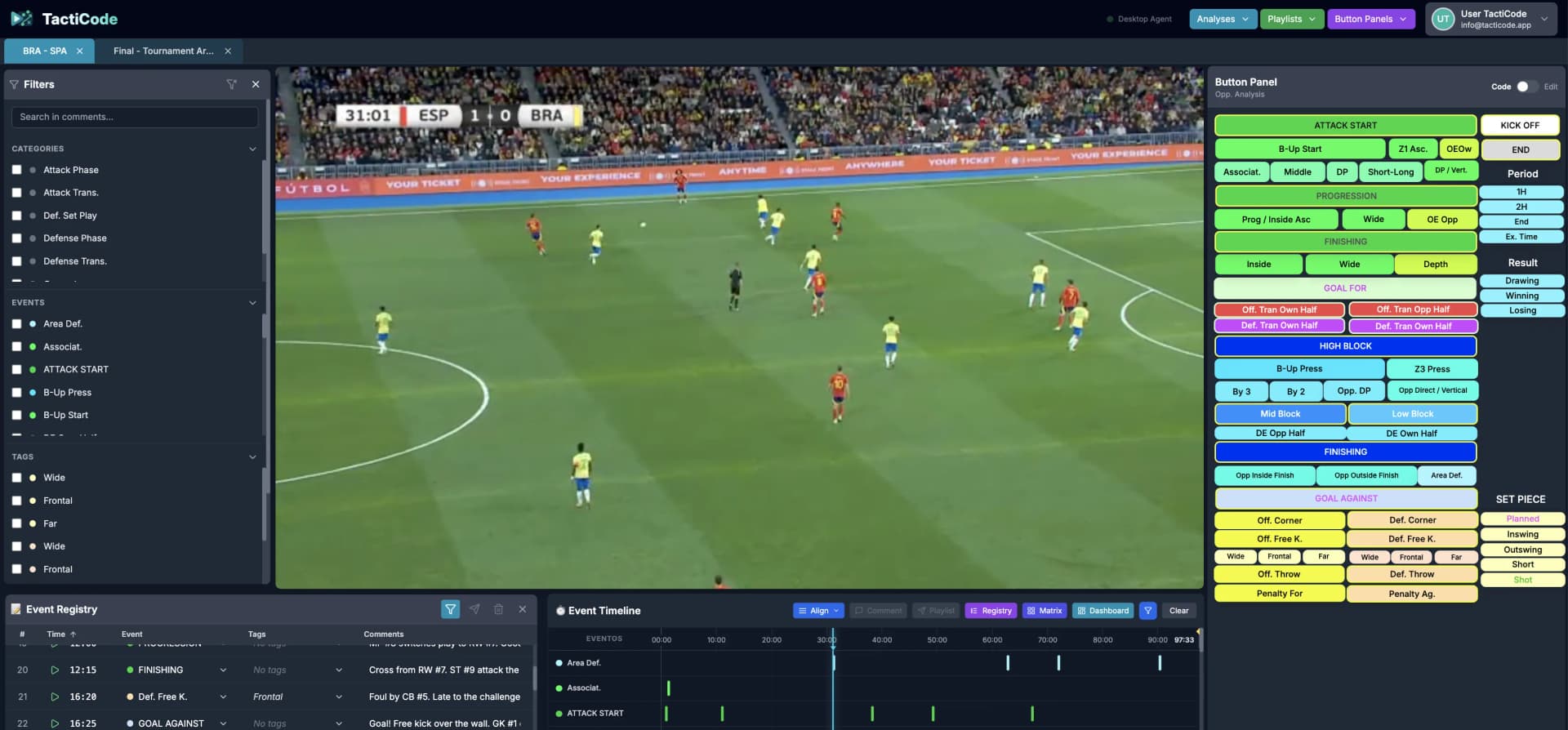
Why Analyze a Soccer Match? (And Where to Start)
It has happened to all of us. We are curious to understand what happens on the pitch, to decipher what lies behind each team's tactics, to understand what teams do well and where their weaknesses lie.
We want to go beyond watching and enjoying a soccer match: we want to analyze and understand it. But, as we say, it has happened to all of us and we ask ourselves: "Okay... but where do I start?".
Don't worry, because it's the first big step to learning to analyze: analyzing is searching for and finding answers.
And within this search for answers you will have a great technological ally by your side: video analysis software. To avoid making the classic mistakes of sitting in front of the acquired software and starting to cut clips of "things that stand out", we have created this guide. In it, we will try to break down the professional workflow that transforms 90 minutes of football into actionable information to win on the weekend.
Phase 1: The Tactical Analysis Matrix (The Questions)
Before opening your computer, you need to clarify your ideas and set your goal. Grab a pen and paper if necessary and outline a list of concepts you would like to detect for subsequent analysis. If you don't know what you're looking for, you won't find anything.
At TactiCode we call this the "Analysis Matrix". You must define your goals before cutting the first clip.
Examples of Key Analysis Questions
- Own Game Model Based on our players, we are a team with the capacity to recover the ball
- Match Plan We will plan a match based on the counterattack as a defensive weapon
- Individual Performance Did our full-back win his 1vs1 duels? I will have to analyze those individual disputes.
- Scouting and Opponent Analysis What are the strengths and weaknesses of the opposing team? What is their game model?
Phase 2: Designing the Tagging Dashboard (Your Reality Filter)
Once you have the questions, the tagging dashboard (botonera) is your tool to capture the answers.
Do not create an infinite list of actions ("Pass", "Shot"). You will lose time and generate confusion within your own analyses. Stick to tagging game events that will give you valuable information once you review them later. For example, if you are going to analyze an opponent and their game model, you can organize your dashboard by Game Phases and tactical concepts. Within these concepts should be the answers to the questions we are looking for.
Logical Structure for Organizing Your Dashboard
Organized Attack
Build-up, Creation, Finishing
Organized Defense
High press, Low block
Transitions
Attack-Defense, Defense-Attack
Set Pieces (ABP)
Corners, Free Kicks, Penalties
In TactiCode, you can create unlimited categories and buttons, allowing you to adapt the template exactly to what your team needs to observe in that match, block of matches, or training sessions. Furthermore, within the analysis itself, you can edit the dashboard if you detect an event you hadn't foreseen. Forget about rigid and immovable event panels: welcome to the dynamism of TactiCode.
[01]Professional Dashboard Example
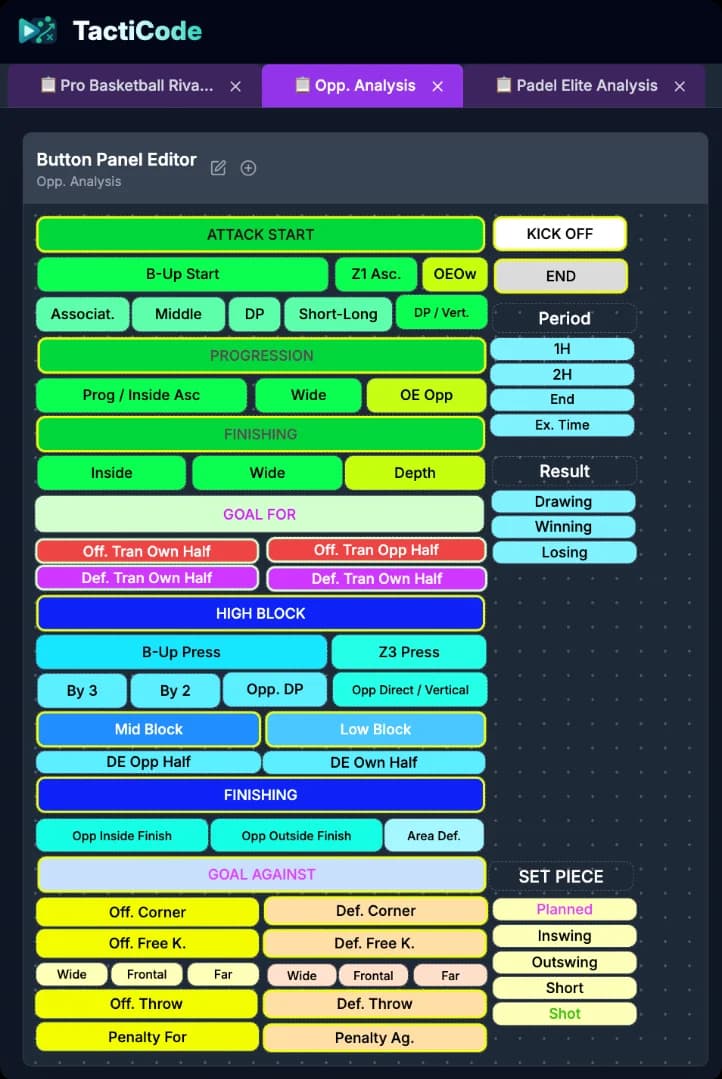
Organize your actions by game phases for a structured analysis
Phase 3: Video Tagging (Capturing the Data)
Now, let's go to the video. You have two ways to work with tagging:
- Post-Match / Training Load the video into the video analysis software and analyze calmly.
- Live Tagging You are in the stands or on the bench. Mark the clips in real-time using your dashboard.
The key here is fluidity. Your video analysis software should not be an obstacle.
When tagging, try to add "surnames" to the action. Don't just mark "Loss". Use the tags from your dashboard: "Loss" + "Start Zone" + "Due to bad control". These tags will serve to add context to the actions and subsequently help us filter if we want events in more specific situations. Likewise, remember that you can add comments to actions to add more information, describe situations, or even easily identify some actions when you proceed to filter later.
Pro Tip
Do not try to analyze everything in a single pass. Do a first quick viewing (even at 1.5x or 2x speed if you feel ready) to tag key events. Then, dig deeper.
Phase 4: Tactical Analysis (Filter and Observe)
Here is where the magic happens. You already have 50 or 60 clips. Do you send them all to the coach? No. Your job is to clear the noise. Use the Filters and the Data Matrix to cross-reference the information you tagged in Phase 3.
Example: Filter only "Defensive Transitions" where there was an "Opponent Chance".
Result: You may find several clips. Those are the ones that matter most, for sure. Watch them, analyze what happens, and detect the error pattern. There you will find the keys to tactical analysis.
Pro Tip
Professional analysis is not measured by the quantity of clips, but by the precision of the conclusions. Less is more when each clip tells a clear story.
Phase 5: The Video Playlist (Communicate to Win)
The last step is communication. The best tactical analysis is useless if the player doesn't understand it.
Send your filtered clips to a Playlist. From there you can shape your story, what you want to tell or show. In this playlist will be the definitive video clips. In addition, you should reinforce this presentation with images or even drawing on match frames to highlight movements, spaces, or whatever you need.
Keys for Effective Presentation to the Team
- Be visual Use drawing tools (arrows, circles, zones) to direct the player's eye. You can also add slides and images to separate sections or add more information.
- Be brief No one maintains attention for more than 8-10 minutes. Select quality over quantity.
- Be constructive Use video to correct, but also to reinforce what has been done well.
Conclusion: The Professional Video Analysis Method
Video analysis does not depend on having a millionaire budget, it depends on having a method and knowledge of the game. For the latter, we must be lovers of the sport, in this case soccer (football), know the details of what happens in the match to the maximum, the game phases, the analysis of more micro actions, and so on. For the work methodology, what is certain is that we will need a technological ally like video analysis software to help us in this analytical process.
Of course, we should not understand tactical analysis as a science with a single method. Every master has their own book, and every analyst or coach has their own methodology. However, after years of experience in the sector, we can determine that the workflow for tactical analysis applied to almost any sports discipline is practically the same:
If you have a clear method, tools like TactiCode allow you to execute it with professional speed and without limits, whether in an academy team or at the elite level.
Ready to apply this tactical analysis method? Use our app, create your first dashboard and your first analyses today.
Want to analyze like a pro?
Try TactiCode for free today. No hidden fees, no complex installations.
Access Beta